
Concrete overlays in NYC are a cost-effective, fast, and minimally disruptive solution for repairing damaged, cracked, or worn concrete floors — without demolition or full replacement. Professionally installed overlays cost $5–$18 per square foot, depending on system type, and can be completed in 1–5 days. They’re suitable for residential lofts, commercial restaurants, warehouses, retail stores, and office spaces across Manhattan, Brooklyn, and all five boroughs. High-performance overlays last 10–20+ years with proper maintenance.
Your NYC Concrete Floor Doesn’t Have to Be Torn Out to Be Fixed
Walk into almost any older New York City building — loft apartment, restaurant, retail store, or warehouse — and you’ll find the same problem: concrete floors that have seen better days. Cracks running across the surface. Spalling patches where the top layer has popped off. Uneven sections that catch your eye and catch your foot.
The instinct for most building owners is to assume the whole floor needs to go. Rip it out, pour new concrete, start fresh. But in NYC — where construction disruption means lost business days, contractor delays, permit paperwork, and costs that escalate fast — that’s rarely the right call.
Here’s the smarter solution: concrete overlays NYC. A properly specified and installed overlay system goes over your existing concrete — repairing damage, leveling uneven surfaces, and delivering a fresh, durable, often decorative finish in a fraction of the time and cost of replacement. Floor repair concrete overlays NYC are used across the city in everything from Brooklyn restaurant renovations to Manhattan loft restorations to industrial floor repairs in Queens warehouses.
This guide covers every aspect of the decision — what overlays are, when they work, what they cost, and which system is right for your specific NYC floor. By the end, you’ll know exactly whether an overlay is the right move for your property.
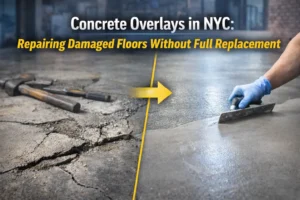
Table of Contents
- What Is a Concrete Overlay? The Clear Definition
- Overlay vs Full Replacement — The NYC Cost & Time Comparison
- Types of Concrete Overlays: Which System for Which NYC Floor?
- What Floor Damage Can a Concrete Overlay Actually Fix?
- The 5-Step Overlay Installation Process (What to Expect)
- Concrete Floor Overlay Cost in NYC — Real Price Ranges
- How Long Do Concrete Overlays Last in NYC?
- Commercial Concrete Floor Repair NYC — Restaurants, Retail, Warehouses
- Overlay vs Epoxy Coating — Which Is Right for Your Floor?
- Why Surface Prep Is the Most Critical Step in Any NYC Overlay
- FAQ: NYC Concrete Overlay Questions Answered
1. What Is a Concrete Overlay?
A concrete overlay — also called concrete resurfacing NYC — is a thin layer of polymer-modified, cement-based material applied directly over an existing concrete surface. Unlike a new concrete pour, it bonds to the existing slab rather than replacing it.
Think of it as a renovation for your floor. The existing concrete stays in place. The overlay goes on top — filling cracks, correcting surface defects, leveling irregularities, and providing a fresh, finished surface that looks and performs like new concrete. Depending on the system, it can also deliver a completely new aesthetic: polished, stained, textured, or patterned.
What Makes Modern Overlays Different from Old Concrete Patches
- Polymer modification: Modern overlay mixes include acrylic, latex, or epoxy polymers that dramatically improve the bond strength of concrete overlay to existing substrates — tested at 200+ PSI tensile strength in quality systems
- Flexibility: Polymer-modified overlays flex slightly with the substrate, reducing the risk of delamination from building movement — important in NYC’s older building stock
- Thickness control: From 1mm micro topping concrete NYC to 25mm self-leveling systems — the right thickness is matched to the damage level and use case
- Rapid cure: Foot traffic in 4–24 hours. Full cure for vehicle traffic in 72 hours. A significant advantage over new concrete pours that require 28-day cure cycles
2. Overlay vs Full Replacement — The NYC Cost and Time Comparison
This is the core decision every NYC property owner faces when their concrete floor deteriorates. The concrete overlay vs replacement NYC question has a clear answer in most cases — and it’s almost never full replacement.
| Factor | Concrete Overlay | Full Replacement |
| Cost (NYC, installed) | $5–$18 per sq ft | $15–$35+ per sq ft |
| Timeline | 1–5 days | 7–14+ days |
| Business disruption | Minimal — section by section | Major — full closure required |
| Demolition required? | No | Yes — jackhammer + haul-out |
| NYC permits typically needed? | Usually No | Often Yes — DOB filing |
| Dust and debris | Minimal | Significant — dumpsters required |
| Can repair cracks? | Yes (with proper prep) | Yes |
| Can level uneven surface? | Yes — SLU systems | Yes |
| Decorative options | Extensive — stain, polish, texture | Limited to surface finish |
| Best for | Damaged surface + aesthetic upgrade | Structural slab failure only |
The math in NYC is stark. A 2,000 sq ft restaurant floor needing repair: overlay system at $10/sq ft = $20,000, completed in 3 days. Full replacement at $25/sq ft = $50,000, with 10–14 days of full closure. For most NYC commercial operators, the business interruption cost of replacement alone exceeds the entire overlay project budget.
Full replacement is only the right answer when the concrete slab has structural failure — meaning the substrate itself has collapsed, the rebar is severely corroded, or moisture intrusion has undermined the base. For surface and near-surface damage, which represents the vast majority of floor deterioration in NYC buildings, damaged concrete floor repair NYC via overlay is the technically correct and economically superior choice.
3. Types of Concrete Overlays: Which System for Which NYC Floor?
Not all overlays are the same. The right system depends on the degree of damage, the floor’s current condition, the intended use, and the aesthetic requirements. Here’s the complete guide:
| Overlay Type | Thickness | Best For | NYC Use Case | Est. Cost/Sq Ft |
| Microtopping | 1–3mm | Aesthetic resurfacing | Loft apartments, restaurants, boutique retail | $6–$10 |
| Self-Leveling (SLU) | 3–25mm | Uneven / badly damaged floors | Warehouses, offices, commercial interiors | $5–$9 |
| Skim Coat Overlay | 1–2mm | Minor surface imperfections | Residential, light commercial | $3–$6 |
| Stampable Overlay | 6–12mm | Decorative patterns + texture | Lobby floors, retail, outdoor patios | $8–$15 |
| Epoxy Mortar System | 6–12mm | Heavy industrial/chemical resistant. | Commercial kitchens, factories | $7–$12 |
| Thin-Set Overlay | 3–6mm | Moderate damage repair | Retail, hospitality, light industrial | $5–$9 |
Microtopping — The NYC Loft and Restaurant Standard
Micro topping concrete NYC is a 1–3mm ultra-thin cement-based overlay that creates a seamless, contemporary surface. It’s the system you see in virtually every high-end Manhattan loft renovation, Brooklyn restaurant, and SoHo retail space. It doesn’t hide structural damage — that’s not its job. It requires a sound, prepped substrate and delivers a polished, matte, or textured finish that looks architectural-grade. Duraamen’s microtopping systems are polymer-modified for improved flexibility and adhesion in NYC’s variable climate conditions.
Self-Leveling Overlay — The Best Fix for Uneven NYC Floors
Self-leveling concrete overlay NYC is the correct specification when the floor has significant height variation — typically more than 3mm across a 10-foot span. The material flows to find level under gravity, filling low spots and creating a flat, bondable substrate. Often used as a base coat under microtopping or decorative systems, or as a standalone system in commercial and industrial spaces where aesthetics are secondary to function.
4. What Floor Damage Can a Concrete Overlay Actually Fix?
Understanding what overlays can and can’t address is critical to specifying the right solution. Here’s the honest breakdown:
Problems Overlays Solve
- Surface cracks: Cracked concrete floor repair NYC — hairline to medium cracks (up to 3–4mm wide) are filled and bridged by overlay systems. Wide structural cracks require pre-filling with epoxy injection before overlay application
- Spalling and delamination: Spalling concrete floor NYC — where the surface layer has separated and popped off — is the most common problem that overlay addresses. The damaged surface is removed, the substrate is profiled, and the overlay is applied
- Surface staining and discoloration: Oil, chemical, or water staining that has penetrated the surface is encapsulated by the overlay system — eliminating the aesthetic problem without replacement
- Minor to moderate height variation: Uneven concrete floor fix NYC — SLU systems correct height differentials up to 25mm in a single pour
- Worn and pitted surfaces: High-traffic commercial floors that have lost their surface finish are ideal overlay candidates — the worn surface provides a rough profile that promotes excellent overlay adhesion
When Overlay Is NOT the Answer
- Structural slab failure: If the concrete slab itself has lost structural integrity — crumbling throughout its depth, severely undermined by moisture, or with failed reinforcement — overlay is not a repair solution. Full replacement is required
- Active moisture intrusion: Moisture vapor emission test readings above ASTM limits must be addressed before any overlay application. Applying over a wet slab will cause delamination
- Cracks wider than 6mm with ongoing movement: Active structural cracks that continue to move require structural repair before overlay — otherwise the crack will reflect through the overlay material
5. The 5-Step Concrete Overlay Installation Process in NYC
Understanding the installation process helps you evaluate contractor quality and set realistic expectations for your project timeline:
- Surface inspection and testing: ICRI concrete restoration standards require assessment of slab condition, crack mapping, moisture vapor emission testing (MVER), and surface profile evaluation (CSP rating). Duraamen’s site visits include all of these before specification
- Mechanical surface preparation: Concrete floor grinding NYC — diamond grinding or shot blasting creates the CSP (concrete surface profile) required for overlay adhesion. This step is non-negotiable. Overlays applied without proper prep will delaminate. Period.
- Crack repair and substrate correction: Active cracks are filled with rigid or flexible epoxy, depending on whether they’re structural or cosmetic. Spalled areas are repaired. Severely uneven sections may receive a first-coat SLU application to establish a level
- Primer application: Penetrating primer seals the prepared substrate, blocks residual moisture migration, and creates a chemical bond surface for the overlay. Primer selection depends on the overlay system and substrate condition
- Overlay application and finishing: The overlay material is applied by trowel for microtoppings, by gauge rake and smoother for SLU systems, by stamp for decorative overlays. Multiple coats are applied for thicker systems. The final sealer or topcoat is applied after cure
6. Concrete Floor Overlay Cost in NYC — Real Price Ranges
The #1 question before any concrete floor overlay cost NYC project: what will it actually cost? Here are the current NYC market rates for professionally installed systems:
| Overlay Type | Price/Sq Ft | 1,000 Sq Ft Job | Timeline | What’s Included |
| Basic skim coat | $3–$6 | $3,000–$6,000 | 1 day | Prep, skim, seal |
| Microtopping (2 coats) | $6–$10 | $6,000–$10,000 | 2–3 days | Prep, 2 coats, topcoat |
| Self-leveling overlay | $5–$9 | $5,000–$9,000 | 1–2 days | Prep, SLU pour, seal |
| Stampable overlay | $8–$15 | $8,000–$15,000 | 3–4 days | Full prep, base, stamp, seal |
| Epoxy mortar system | $7–$12 | $7,000–$12,000 | 2–3 days | Shot blast, mortar, topcoat |
| Full system (SLU + micro) | $10–$18 | $10,000–$18,000 | 3–5 days | Full system install |
These prices reflect professional concrete overlay contractor NYC rates, including labor, materials, surface prep, and standard sealer/topcoat. NYC project pricing is influenced by: floor accessibility (elevator-only buildings add cost), existing damage severity (more prep = higher cost), project size (larger projects lower per-sq-ft cost), and finish specification (decorative systems cost more than functional systems).
Cost Comparison: Overlay vs Epoxy vs Replacement
| Solution | Cost/Sq Ft (NYC) | Best Lifespan | Best For |
| Concrete overlay | $5–$18 | 10–20+ years | Repair + aesthetics |
| Epoxy coating | $3–$8 | 5–10 years | Industrial/garage |
| Full replacement | $15–$35+ | 30+ years (slab) | Structural failure only |
7. How Long Do Concrete Overlays Last in NYC?
How long do concrete overlays last? — This is consistently one of the top People Also Ask questions for this topic. The answer depends on three variables:
- System quality: High-performance polymer-modified overlay systems from tested manufacturers — like Duraamen’s engineered systems — last significantly longer than commodity materials. Quality matters more than any other factor
- Surface preparation: Correctly prepped surfaces (CSP 3–4 for most overlay systems) deliver full lifespan. Poor prep — the leading cause of early overlay failure — can reduce this to 2–3 years before delamination
- Use and maintenance: A properly sealed and maintained microtopping in a residential loft will outlast the same system in an unsupported commercial kitchen
| Overlay System | Typical NYC Lifespan | High-Traffic Lifespan | Maintenance Required |
| Microtopping (sealed) | 10–15 years residential | 7–12 years commercial | Annual resealing |
| Self-leveling overlay | 15–25+ years | 10–20 years | Periodic resealing |
| Epoxy mortar system | 15–20 years | 10–15 years industrial | Low — durable topcoat |
| Stampable overlay | 10–18 years | 8–15 years | Resealing every 2–3 yrs |
8. Commercial Concrete Floor Repair NYC — Restaurants, Retail, and Warehouses
The majority of commercial concrete floor repair NYC projects are driven by one of three realities: health code compliance, customer-facing appearance, or operational safety. Duraamen works across all three NYC commercial contexts:
Restaurant Floor Repair NYC
Restaurant floor repair NYC has specific requirements that residential or standard commercial projects don’t: NSF-compliant surfaces, chemical resistance to grease and cleaning agents, cove base detailing for health code compliance, and slip resistance ratings for front and back of house. Epoxy mortar overlay systems with appropriate topcoats are typically specified for commercial kitchen floors. Microtopping with penetrating sealers is common for front-of-house dining areas and bar spaces.
Retail Floor Repair NYC
Retail floor overlays in NYC need to balance decorative concrete overlay NYC aesthetics with durability under high foot traffic. Microtopping in custom colors, polished overlays, and stained systems are popular in SoHo, Williamsburg, and Midtown retail environments. These systems create a premium store environment at a fraction of tile or hardwood flooring costs — and with a single-day installation timeline that minimizes retail disruption.
Warehouse and Industrial Floor Repair NYC
Warehouse floor repair NYC priorities are different: maximum abrasion resistance, forklift traffic tolerance, chemical resistance, and easy cleaning. Self-leveling overlay systems with polyurethane or epoxy topcoats are standard specifications. In Long Island City, Bushwick, and Mott Haven industrial corridors, Duraamen installs heavy-duty overlay systems that handle pallet jack and forklift traffic without surface deterioration.
9. Concrete Overlay vs Epoxy Floor Coating — Which Is Right for Your NYC Floor?
Buyers frequently compare epoxy floor coating NYC against concrete overlay systems. Here’s the honest comparison:
| Factor | Concrete Overlay | Epoxy Floor Coating |
| Thickness | 1–25mm — covers more damage | 0.5–3mm — limited depth |
| Repair capability | Fills cracks + levels surface | Fills minor cracks only |
| Aesthetics | Matte, polished, textured, stained | Glossy, chip, metallic |
| NYC typical use | Residential, restaurant, retail, office | Garage, industrial, utility |
| Lifespan | 10–20+ years | 5–10 years |
| Hot tyre resistance | Good (polymer systems) | Poor — can peel in hot weather |
| Look and feel | Concrete — natural, architectural | Plastic — synthetic appearance |
For most NYC commercial and residential applications, concrete overlay is the superior choice — particularly for spaces where aesthetics matter. Epoxy has its place in utility spaces, garages, and industrial floors where the glossy, easy-clean surface is preferred over an architectural appearance.
10. Why Surface Prep Is the Most Critical Step in Any NYC Overlay Project
This section exists because surface preparation is the single most important factor in overlay success — and the most frequently compromised step when buyers choose the lowest-cost contractor.
The CSP surface profile (Concrete Surface Profile) determines adhesion. ICRI concrete restoration standards specify CSP 3–5 for most overlay systems — the equivalent of 60–80 grit sandpaper at the macro scale. This is achieved by diamond grinding, shot blasting, or scarifying — all mechanical processes that cannot be replaced by acid etching or simple cleaning, regardless of what a low-cost contractor tells you.
Why NYC Overlays Fail — The Most Common Causes
- Inadequate surface profile: Overlay applied over an insufficiently prepared surface. Bond fails within months. The most common failure cause in NYC overlay projects
- Moisture not tested or addressed: Moisture vapor emission test skipped. Moisture migrates through the slab and breaks the overlay bond from below. Critical in basement and ground-floor NYC spaces
- Wrong product for the damage level: A 2mm microtopping applied over a floor with 6mm height variation. Wrong specification, wrong result
- Insufficient cure time between coats: Rushing the job. Each coat must reach the specified strength before the next is applied. Skipping cure time creates a stack of layers without cross-bonding
Duraamen’s installation process follows ICRI concrete restoration standards on every project — surface testing, moisture assessment, correct CSP specification, and appropriate product selection before any material goes on the floor.
The Right Answer for Most Damaged NYC Floors: Overlay, Not Replacement
The pattern is clear: for the overwhelming majority of damaged concrete floors in New York City — cracked, spalled, uneven, stained, or worn — concrete overlays NYC deliver a better outcome than full replacement. Less disruption. Significantly lower cost. Faster completion. And a finished result that often looks better than the original.
The key variables are specification and installation quality. The right overlay system for your floor damage type, correctly prepped and installed to ICRI concrete restoration standards, will last 10–20+ years in NYC’s demanding environment. A poorly specified or installed overlay will fail prematurely and cost you more in the long run.
Duraamen has been specifying and installing high-performance concrete overlay systems in New York City for years — across every property type, every borough, and every damage scenario. We bring the product knowledge, the installation standards, and the project management experience to deliver results that hold up.
|
Need a Concrete Overlay Estimate for Your NYC Property? Duraamen has been providing high-performance concrete overlay systems across New York City for years — serving residential lofts, commercial restaurants, retail spaces, and industrial warehouses. We assess your floor, specify the right system, and deliver a seamless, durable result that lasts. Request Your Free NYC Estimate → nyc.duraamen.com |
FAQ — Concrete Overlays NYC: Your Questions Answered
How much does it cost to do a concrete overlay in NYC?
Professional concrete floor overlay cost NYC: basic skim coat $3–$6/sq ft, microtopping $6–$10/sq ft, self-leveling overlay $5–$9/sq ft, stampable decorative overlay $8–$15/sq ft, full system $10–$18/sq ft. All prices include surface preparation, material, installation, and standard sealer. NYC-specific factors like elevator-only access or severe damage increase cost. Duraamen provides detailed written estimates for every project.
Can a concrete overlay be repaired if it gets damaged?
Yes — concrete overlay damage (chips, cracks, wear areas) can typically be spot-repaired using the same overlay system. The repair area is cleaned, lightly abraded, primed, and patched with compatible material. For sealed systems, the repair is resealed to match. This is significantly easier and cheaper than repairing damaged tile or hardwood — and often achievable without visible seams in trowel-applied microtoppings.
What are the disadvantages of a concrete overlay?
Honest answer: (1) Overlays can’t fix structural slab failure — if the base concrete is failing, an overlay isn’t the solution. (2) They require more precise surface preparation than replacement — poor prep leads to delamination. (3) Very thin overlays (microtopping) are less forgiving of substrate movement. (4) Not all damage types are compatible — active wide cracks require pre-treatment. (5) In NYC’s high-traffic commercial environments, some systems require periodic resealing. With correct specification and installation, most of these limitations are manageable.
How long will a concrete overlay last in NYC?
High-performance professionally installed overlays last 10–20+ years with proper maintenance. Moisture vapor emission testing, correct CSP surface prep, appropriate system selection, and quality sealer application are the key lifespan factors. Residential microtoppings with annual resealing regularly achieve 15+ years. Heavy-duty commercial systems in industrial environments typically last 10–18 years before resurfacing is needed.
Can you pour or apply concrete over existing damaged concrete?
Yes — this is precisely what concrete overlays in NYC accomplish. The key requirement is that the existing concrete has sufficient structural integrity (it’s not crumbling or failing throughout its depth) and that proper surface preparation is performed. Self-leveling overlays go up to 25mm thick in a single application. Thicker systems can be built up in multiple coats. The overlay bonds chemically and mechanically to the prepared substrate.
Is a concrete overlay a good idea for a NYC restaurant floor?
Yes — for both front and back of house. For kitchen areas: epoxy mortar overlay with chemical-resistant topcoat meets NYC health code requirements for cove base and non-porous surfaces. For dining areas: microtopping or polished overlay creates a contemporary architectural aesthetic at a fraction of tile cost, with a 2–3 day installation timeline that minimizes closure. Restaurant floor repair in NYC is one of Duraamen’s most common project types across all five boroughs.
Do concrete overlays in NYC require permits?
For most interior concrete overlay projects — residential and commercial — NYC DOB permits are not required because no structural work is being done and the overlay is a surface treatment, not a structural modification. Projects involving structural slab repair, changes to building systems, or certain commercial kitchens may require permits. Duraamen’s team advises on permit requirements during the pre-project assessment.
What is the thinnest concrete overlay available?
Micro topping concrete NYC systems go as thin as 1mm (1/25 inch). These ultra-thin applications are purely aesthetic — they don’t fill significant cracks or level uneven surfaces. For crack repair or leveling, the minimum overlay thickness is 3mm (self-leveling) to 6mm (stampable). The right thickness is determined by the substrate condition, not by preference — applying too thin a coat over damaged concrete produces a poor result regardless of product quality.
Which NYC boroughs do you serve for concrete overlay projects?
Duraamen’s NYC team serves all five boroughs — Manhattan, Brooklyn, Queens, the Bronx, and Staten Island — as well as Long Island City, Astoria, and surrounding areas. Concrete floor repair in Manhattan projects are common (loft apartments, restaurants, office buildings). Concrete floor repair in Brooklyn spans Williamsburg, DUMBO, and Bushwick commercial and residential projects. Contact Duraamen at nyc.duraamen.com for a free site assessment in your area.