
If you’ve ever walked into a NYC basement and smelled that musty dampness — or noticed white powdery residue creeping up the walls — you already know the problem. Moisture is the #1 enemy of every cellar floor in NYC, and if left untreated, it doesn’t just ruin your floor. It invites mold, damages structural integrity, and kills your property value.
Here’s the thing: New York’s underground environments are uniquely harsh. High water tables, aging infrastructure, seasonal temperature swings, and dense urban soil pressure make moisture control flooring in NYC a non-negotiable priority — not an optional upgrade.
In this guide, we’ll break down the best basement floor coating systems, what actually works for NYC’s specific conditions, how to choose the right solution for your space, and why Duraamen is the name New York property owners trust for long-lasting floor coatings that perform year after year.
Table of Contents
- Why NYC Basements Are Uniquely Vulnerable to Moisture
- Basement vs. Cellar: Key Differences for Flooring Decisions
- Best Basement Moisture-Resistant Flooring Options
- Understanding Basement Floor Coating Systems
- Concrete Basement Floor Coating NYC: What to Expect
- Moisture Vapor Barriers & Waterproof Membranes
- Prep Work: Why Surface Preparation Matters Most
- Radiant Heat Compatible Floors & Other Smart Upgrades
- How Much Does Basement Floor Coating Cost in NYC?
- Choosing the Right NYC Basement Floor Solutions Provider
- FAQ
Why NYC Basements Are Uniquely Vulnerable to Moisture
Most cities have basement moisture issues. But New York City takes it to another level. Here’s why.
Manhattan, Brooklyn, Queens — much of NYC sits on rock and clay-heavy soil with high groundwater tables. The island of Manhattan itself is surrounded by water. That means hydrostatic pressure constantly pushes moisture through concrete slabs, walls, and floors, even in buildings with no visible cracks.
Add to that:
- Aging building stock — many NYC basements are 50–100+ years old, with outdated waterproofing or none at all
- Steam heat systems — old-school radiators create massive humidity swings that stress floors year-round
- Urban heat island effect — amplifies condensation issues during the summer months
- Seasonal freeze-thaw cycles — water expands in concrete cracks during winter, accelerating deterioration
This is exactly why generic flooring advice doesn’t cut it for NYC basement floor solutions. You need coatings and systems specifically engineered for high-moisture, high-stress underground environments.
| Pro Insight: According to building experts, moisture vapor transmission (MVT) through concrete slabs is measured in pounds per 1,000 square feet per 24 hours. NYC slab conditions often exceed 5–8 lbs — well above what standard coatings can handle without specialized primer systems. |
Basement vs. Cellar: Key Differences That Affect Flooring
In New York City, the terms basement and cellar aren’t just casual synonyms — they’re legally defined by NYC Housing Preservation & Development (HPD), and the distinction matters a lot for flooring decisions.
| Feature | Basement (NYC) | Cellar (NYC) |
| Definition | Partly below grade; at least half its height above curb level | Entirely or mostly below grade |
| Can be habitable? | Yes, with proper permits & egress | No — not legally habitable |
| Moisture exposure | Moderate to high | High to extreme |
| Floor coating priority | High — moisture + foot traffic | Critical — moisture mitigation first |
| Typical floor use | Living space, gym, office | Storage, mechanical, utility |
Whether you’re dealing with a cellar flooring NYC situation or a finished basement, the flooring strategy differs — but moisture control is always the first priority in both cases.
Best Basement Moisture-Resistant Flooring Options
Not all flooring handles moisture the same way. Here’s an honest breakdown of what works — and what doesn’t — for basement moisture resistant flooring in New York:
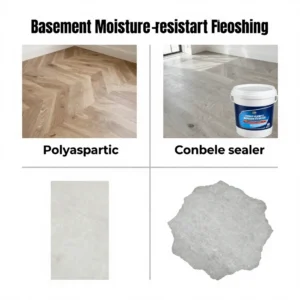
1. Polyaspartic Floor Coatings (Top Choice for 2026 -2027)
Polyaspartic coatings are currently the gold standard for NYC basement floors. They cure in as little as 24 hours (crucial for occupied properties), handle extreme moisture vapor transmission, and resist UV, chemicals, and abrasion.
- Cure time: 1–2 days (vs. 7+ days for standard epoxy)
- Moisture tolerance: Works even at relative humidity up to 90%
- Flexibility: Won’t crack with NYC’s temperature cycling
- Ideal for: High-traffic basements, converted living spaces
2. Epoxy Floor Coatings
A proven workhorse for basement epoxy floor coatings in NYC. Epoxy creates a seamless, hard, chemical-resistant surface that blocks moisture from below — but requires thorough surface prep and a moisture vapor barrier primer in high-MVT environments.
- Best for: Storage areas, mechanical rooms, utility spaces
- Watch out for: Moisture blistering without a proper primer system
- Cost range: $3–$7/sq ft installed
3. Moisture Vapor Resistant (MVR) Epoxy Systems
Specifically engineered moisture vapor barrier flooring systems use a special primer that chemically bonds to concrete while blocking vapor drive from below. This is what Duraamen recommends when slab moisture readings are elevated.
4. Concrete Sealers & Surface Treatments
For cellars or utility spaces where a full coating isn’t practical, quality concrete sealers for basement floors can reduce moisture infiltration by 60–80%. Penetrating sealers work below the surface; topical sealers add a protective film layer. Neither is a substitute for a full coating system in habitable spaces.
5. What to Avoid
Some flooring options are commonly sold as ‘basement-friendly’ but struggle in NYC’s conditions:
- Laminate flooring — swells and buckles with moisture fluctuations
- Hardwood (traditional) — warps in high-humidity underground environments
- Carpet — traps moisture, becomes a mold factory underground
- Vinyl plank without a moisture barrier — can delaminate over time on high-MVT slabs
Understanding Basement Floor Coating Systems
A proper basement floor coating system isn’t just a single product — it’s a layered approach:
- Moisture test & surface assessment — Calcium chloride or RH probe test to measure vapor transmission
- Mechanical surface preparation — Diamond grinding or shot blasting to open the concrete’s pores
- Crack repair — Polyurethane or epoxy injection for structural and non-structural cracks (basement floor crack repair NYC)
- Moisture vapor barrier primer — Applied when MVT exceeds 3 lbs/1,000 sq ft/24 hrs
- Base coat — Epoxy, polyaspartic, or polyurea base for build and adhesion
- Decorative layer — Optional flake broadcast, quartz aggregate, or metallic pigments
- Top coat sealer — UV-stable, abrasion-resistant clear coat for protection and sheen
| Real Talk: Many ‘budget’ coating jobs skip steps 1–3. That’s why floors start peeling within 2–3 years. At Duraamen, every NYC project starts with a proper moisture assessment — no shortcuts. |
Concrete Basement Floor Coating NYC: What to Expect
If your basement has a bare concrete slab — which is true for most older NYC buildings — a professional concrete basement floor coating NYC job will transform both appearance and function.
Here’s what a quality installation timeline looks like:
| Day | Activity | Notes |
| Day 1 | Site assessment + moisture testing | No prep skipped — ever |
| Day 1–2 | Surface grinding/shot blasting | Opens concrete for maximum adhesion |
| Day 2 | Crack injection & floor leveling | Basement floor leveling & drainage check |
| Day 2–3 | MVB primer application | Critical for NYC high-MVT slabs |
| Day 3–4 | Base coat + flake/quartz broadcast | Color and texture selection |
| Day 4–5 | Top coat sealer application | Final curing & inspection |
| Day 5–7 | Ready for light foot traffic | Full cure: 7–10 days |
Professional basement floor coating contractors NYC like Duraamen handle everything from assessment to final inspection — and stand behind their work with a written warranty.
Moisture Vapor Barriers & Waterproof Membranes: Do You Need One?
Short answer: In NYC, usually yes. Here’s the longer version.
Concrete is porous. Even a ‘dry’ slab constantly moves moisture from the soil below — it just happens slowly. Over time, this vapor drive breaks down adhesives, traps water beneath coatings, and leads to bubbling, peeling, or mold growth underneath finished flooring.
Waterproof floor membranes — whether applied as liquid-applied systems or sheet membranes — create a physical barrier between the concrete and your finished floor. For NYC cellar floor moisture control, this step is non-negotiable in most cases.
When you definitely need a moisture vapor barrier:
- Slab moisture readings above 3 lbs per 1,000 sq ft
- Visible efflorescence (white salt deposits) on the existing slab
- History of water intrusion or flooding
- Planning to install finished flooring over concrete
- Ground-level or below-grade spaces in clay-heavy NYC soil
Surface Preparation in NYC: The Step Most Contractors Skip
Here’s an uncomfortable truth: most coating failures aren’t about the product — they’re about the prep.
Basement surface preparation in NYC is genuinely the most important part of any flooring project. Diamond grinding opens the concrete’s surface profile to the right CSP (Concrete Surface Profile) grade, which determines how well the coating bonds.
What proper prep includes:
- Shot blasting or diamond grinding — never acid etching alone for NYC slabs
- Dust containment systems — essential for occupied buildings and shared spaces
- Crack mapping and repair — every crack documented and addressed before coating
- Floor leveling — self-leveling compounds are used where slopes or low spots exist
- Drain verification — checking basement floor leveling & drainage before sealing
At Duraamen, we use industrial-grade dust-shrouded grinders that keep your property clean during prep — critical for residential NYC buildings where mess affects neighbors and common areas.
Radiant Heat Compatible Floors & Smart 2026 Upgrades
Cold basement floors are a major complaint in NYC homes. If you’re considering in-floor radiant heat, it’s important to choose flooring that’s radiant heat compatible and won’t delaminate under thermal cycling.
Good news: Polyaspartic and polyurea coatings are both radiant-heat compatible. Here’s why they’re ideal:
- Flexible enough to expand and contract with heat cycles
- Don’t off-gas or degrade at typical radiant heat temps (65–85°F)
- Seamless surface doesn’t trap dust or allergens — improving air quality in basement spaces
- Supports indoor moisture control systems and HVAC integration
Looking ahead to 2026–2027, expect more NYC property owners to combine radiant floor heat + high-performance coatings + active dehumidification systems as the standard basement upgrade package — especially in brownstone renovations and luxury residential conversions.
How Much Does Basement Floor Coating Cost in NYC?
Let’s be real — basement floor coating cost in NYC varies a lot. Here are honest estimates based on typical project types:
| Project Type | Scope | Estimated Cost (Per Sq Ft) |
| Basic concrete sealer | Cellar or storage only | $1.50 – $3 |
| Standard epoxy system | 2-coat system, no MVB | $3 – $5 |
| Epoxy + MVB primer | High-moisture slab | $5 – $8 |
| Polyaspartic full system | Living space, high-end finish | $6 – $10 |
| Full polyurea system | Heavy-duty, commercial-grade | $8 – $14 |
| Crack repair add-on | Per linear foot | $15 – $40/LF |
Factors that affect price in NYC specifically: building access (elevator vs. stairs), DOB requirements for occupied buildings, labor costs in the five boroughs, and the specific moisture mitigation needs of your slab.
| Important: Cheapest isn’t cheapest long-term. A $2/sq ft coating that fails in 2 years costs you $4–6/sq ft in stripping, re-prep, and recoating — plus the headache. Investing in the right system upfront saves money. |
Why NYC Property Owners Choose Duraamen
When it comes to NYC basement waterproofing services and professional floor coatings, Duraamen stands apart. Here’s what makes the difference:
- NYC-Specific Expertise: We understand the building codes, HPD regulations, and soil conditions unique to the five boroughs — not just generic flooring advice
- Commercial-Grade Products: We use industrial-strength polyaspartic, polyurea, and epoxy systems with documented performance data — the same systems used in warehouses, hospitals, and high-traffic commercial spaces
- Full-System Approach: From moisture testing to final top coat, we don’t cut corners — every phase is documented and verified
- Clean, Professional Installation: Dust containment systems, respectful crews, and minimal disruption to your building’s residents
- Written Warranty: We stand behind our work with a formal warranty — ask any competitor if they do the same
Whether you’re dealing with a leaking cellar in Brooklyn, a moisture-damaged basement in Queens, or a ground-floor conversion in Manhattan, Duraamen has the system and the experience to solve it right the first time.
Visit nyc.duraamen.com to explore our basement flooring systems or request a free consultation.
Explore More from Duraamen NYC
Looking to dive deeper? Here are related topics we cover in detail:
- Epoxy Floor Coatings NYC — Complete guide to commercial and residential epoxy systems
- Polyaspartic vs Epoxy: Which Is Right for Your NYC Space? — Side-by-side comparison for property owners
- Concrete Floor Repair NYC — Crack injection, surface leveling, and restoration services
- Garage Floor Coatings NYC — Same technology, applied to parking and garage environments
- NYC Waterproofing Solutions — Interior and exterior moisture control for buildings
FAQ: Basement & Cellar Flooring in NYC
Q1: What is the best basement flooring for moisture control in NYC?
Polyaspartic coatings with a moisture vapor barrier primer are currently the best option for NYC basement moisture resistant flooring. They cure fast, tolerate high humidity, and handle NYC’s unique groundwater pressure without delaminating.
Q2: How do I prevent moisture under my basement floor?
Start with a professional moisture test (calcium chloride or RH probe). If vapor transmission is elevated, apply a moisture vapor barrier primer before any coating. Also, ensure proper drainage and consider an active dehumidification system for long-term humidity control.
Q3: What floor coatings actually work in NYC basements?
Polyaspartic, polyurea, and MVR epoxy systems are proven performers for concrete basement floor coating in NYC. Standard big-box epoxy kits are not — they lack the moisture tolerance and bond strength needed for NYC’s below-grade conditions.
Q4: How much does basement floor coating cost in NYC?
Typical costs range from $3–$10 per square foot installed, depending on system complexity, slab condition, and moisture mitigation needed. Crack repair, floor leveling, and MVB primers add cost but are often essential for long-term performance.
Q5: What’s the difference between basement and cellar floors in NYC?
In NYC, a basement is partly above grade and can be habitable; a cellar is mostly below grade and is non-habitable. Cellars typically face higher moisture exposure and require more aggressive moisture mitigation flooring solutions.
Q6: Can I use vinyl plank flooring in an NYC basement?
100% waterproof LVP can work for finished basements with moderate moisture levels — but it requires a proper moisture barrier beneath it. On high-MVT slabs, a floating LVP installation over a quality vapor barrier is recommended. For severe moisture issues, a bonded coating system is the more reliable long-term choice.
Q7: How long does a basement floor coating last in NYC?
A properly installed polyaspartic or polyurea system should last 10–15+ years with normal use. Epoxy systems typically last 7–12 years. Lifespan depends heavily on prep quality, moisture management, and foot traffic. Cheap systems often fail within 2–3 years.
Q8: Is basement floor coating safe for air quality?
Yes — once fully cured, professional-grade coatings are inert and don’t off-gas VOCs. During installation, proper ventilation is required. Seamless coatings actually improve indoor air quality by eliminating porous surfaces where mold and bacteria grow.
Don’t Let NYC Moisture Win
Your basement or cellar isn’t just square footage — it’s a potential asset, storage space, or livable area that moisture is actively working to destroy. NYC’s unique conditions demand a smarter approach than whatever’s cheapest or fastest.
The right basement floor coating system — installed correctly, with proper moisture testing and surface prep — will protect your investment for a decade or more. The wrong one will cost you double when it fails in two years.
Duraamen specializes in NYC basement floor solutions built for the city’s real conditions. Polyaspartic systems. Moisture vapor barriers. Professional prep. Written warranties.
Ready to solve your basement moisture problem for good? Visit nyc.duraamen.com or call our NYC team today for a free assessment. Because your floor deserves better than a temporary fix.