
You’ve got a business to run in New York City. Every day your floor is out of commission is money walking straight out the door.
That’s the real reason polyaspartic vs epoxy flooring has become the most searched flooring debate among NYC business owners, contractors, and garage operators in 2025. Because choosing the wrong coating system doesn’t just cost you dollars on installation day — it costs you 3 to 7 days of complete downtime while epoxy slowly cures.
Fast track flooring systems NYC businesses actually need are built around one non-negotiable: get in, get coated, get back to business. And that’s exactly where polyaspartic coatings NYC have completely changed the game.
In this guide, you’ll get a no-fluff, side-by-side breakdown of polyaspartic vs epoxy flooring — cure times, durability, UV performance, real costs, and which system wins for NYC’s specific climate and commercial demands.
Whether you’re coating a garage, restaurant, retail space, or industrial floor — by the end of this article, you’ll know exactly which quick curing concrete floor coating is right for your project.
Let’s get into it.
Table of Contents
- Quick Answer: Which Is Better for Fast-Track NYC Projects?
- What Are Polyaspartic and Epoxy Floor Coatings?
- Polyaspartic vs Epoxy Flooring: The Head-to-Head Comparison
- Why Fast Track Flooring Systems NYC Businesses Need — Downtime Is Money
- Polyaspartic Coatings NYC: 7 Key Benefits You Can’t Ignore
- Epoxy Flooring Disadvantages in NYC’s Climate
- Cost Comparison: Polyaspartic vs Epoxy — What You’ll Actually Pay
- Best Applications: Who Should Choose What?
- NYC-Specific Factors That Change Everything
- Duraamen NYC: Your Fast-Track Floor Coating Partner
- Conclusion
- FAQ — People Also Ask
Quick Answer: Which Is Better for Fast-Track NYC Projects?
If you’re running a business in New York City — a restaurant, garage, retail store, warehouse, or commercial space — and you need your floor done fast, here’s the honest answer:
Polyaspartic coatings win for speed, durability, and UV stability. They cure in 2–4 hours, allow same-day return to service, and outperform epoxy in almost every durability test. Epoxy floor coatings are cheaper upfront but take 3–5 days to fully cure — and in NYC, that’s 3–5 days of lost revenue.
Still, the right choice depends on your budget, floor type, and how much downtime you can actually afford. This guide breaks it all down.
What Are Polyaspartic and Epoxy Floor Coatings?
Before we compare them, let’s quickly clarify what each product actually is — because a lot of people confuse them.
Epoxy floor coating is a two-part resin system (epoxy resin + hardener) that bonds to concrete and creates a hard, rigid surface. It’s been the industry standard for commercial floor coating NYC projects for decades. It works well, but it has real limitations — especially in a city like New York where temperature swings, humidity, and UV exposure are constant challenges.
Polyaspartic coatings are a newer class of polyurea-based coatings. They were developed specifically to address epoxy’s shortcomings. They cure significantly faster, flex with the concrete instead of cracking, resist UV yellowing, and perform better in both hot and cold application conditions.
Think of epoxy as a reliable old truck — it gets the job done, but it’s slow. Polyaspartic is the upgraded model: faster, tougher, and built for 2026 conditions.
Polyaspartic vs Epoxy Flooring: The Head-to-Head Comparison
This is the section most people are actually here for. Let’s go deep.
Cure Time & Return to Service
| Factor | Polyaspartic | Epoxy |
| Full Cure Time | 2–4 hours | 24–72 hours (full: 5–7 days) |
| Walk-on Time | Same day (2–6 hrs) | 12–24 hours |
| Vehicle Traffic | 24 hours | 5–7 days |
| 1 Day Floor Coating NYC | Yes | No |
This is where polyaspartic coatings NYC completely dominate. A fast-cure floor coating like polyaspartic means your shop, garage, or retail floor is operational the next morning. Epoxy cannot make that promise.
Real-world NYC example: A Brooklyn auto dealership needed their showroom floor coated over a weekend. With same-day installation of floor coatings using polyaspartic, the floor was installed Saturday morning, and cars were rolling back in by Sunday afternoon. With epoxy? That same project would have required a week of downtime.
Durability Comparison: Epoxy vs Polyaspartic
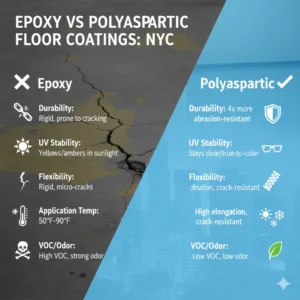
Polyaspartic coatings are 4x more abrasion-resistant than standard epoxy. They’re also more flexible — they move with the concrete as temperatures shift. Epoxy is rigid, which means thermal expansion in NYC summers can cause micro-cracking, delamination, and peeling over time.
For high-traffic concrete floor solutions, polyaspartic is the clear long-term winner.
UV Stable Floor Coating Performance
This is one of epoxy’s biggest and most underrated weaknesses. Standard epoxy is not UV stable. In sun-exposed areas — garages with windows, retail spaces with skylights, exterior concrete — epoxy turns amber/yellow within months.
Polyaspartic floor benefits include full UV stability. It stays clear or true-to-color for years, even in direct sunlight. If you want a UV-resistant concrete coating that won’t embarrass you in front of customers, polyaspartic wins this category by a mile.
Flexibility & Crack Resistance
NYC concrete expands and contracts constantly due to temperature swings. Epoxy, being rigid, doesn’t handle this well. Polyaspartic is formulated to flex — it has higher elongation, meaning it absorbs movement without cracking or delaminating.
For industrial concrete coatings in NYC warehouses, factories, or heavy-use spaces, this flexibility difference can mean the gap between a floor that lasts 10 years and one that needs patching in 3.
Application Temperature Range
This matters more than most people realize. Epoxy needs to be applied between 50°F–90°F with controlled humidity — not always possible in NYC’s variable climate. In winter, many epoxy jobs get delayed or fail because the concrete is too cold.
Polyaspartic coatings can be applied from 0°F to 140°F. Year-round installation. No weather delays. For fast-track flooring systems on tight timelines, this flexibility is a huge operational advantage.
VOC Levels & Odor
Polyaspartic: Low VOC, low odor — safer for occupied spaces, food environments, and green building certifications.
Epoxy: Higher VOC, strong chemical odor during application. You’ll need to vacate the space and ventilate heavily.
For sustainable low VOC floor coatings in NYC — where air quality regulations are strict and occupied buildings are the norm — polyaspartic is the responsible choice.
Why Fast Track Flooring Systems NYC Businesses Need — Downtime Is Money
Let’s talk business reality in New York City.
Your floor goes down on a Friday night. You need to open on Monday morning. That’s not a luxury — that’s survival. NYC rent costs, employee wages, and customer expectations don’t pause because your floor needs to cure.
Epoxy flooring disadvantages become very visible when you calculate the true cost of downtime:
- A mid-size restaurant losing even 2 days of service = $8,000–$15,000 in lost revenue
- A retail space in Manhattan closed for floor work = thousands in lost foot traffic
- A garage or auto shop down for a week = lost client trust + rescheduling nightmares
Quick turnaround floor coatings for businesses aren’t just a convenience — they’re a financial decision. Floor coating with minimal downtime literally pays for itself.
This is exactly why fast-cure floor coating technology like polyaspartic was adopted so aggressively by commercial and industrial operators in NYC. The 20–30% higher upfront cost of polyaspartic over epoxy is often recovered in the first week of uninterrupted operations.
Polyaspartic Coatings NYC: 7 Key Benefits You Can’t Ignore
Here’s a tight summary of why polyaspartic is the dominant choice for fast-track flooring systems in NYC in 2026:
- Cures in 2–4 hours — true 1-day floor coating in NYC is possible
- 4x more abrasion-resistant than standard epoxy — built for heavy traffic
- 100% UV stable — no yellowing, no color shift, stays beautiful for years
- Applies in any temperature — no weather delays, year-round installation
- Low VOC, low odor — safe for commercial spaces, food facilities, occupied buildings
- Flexible, crack-resistant — won’t delaminate as NYC concrete expands and contracts
- Long-term value — fewer repairs, longer warranty on floor coating systems, lower lifecycle cost
For concrete floor coatings for retail spaces, restaurants, garages, showrooms, and industrial facilities — this combination of speed + durability is unmatched.
Epoxy Flooring Disadvantages in NYC’s Climate
Let’s be fair — epoxy is not a bad product. It’s just not the right product for every NYC situation. Here’s where it genuinely falls short:
The 6 Real Epoxy Flooring Disadvantages:
- Slow cure time — 5–7 days for full cure, meaning extended business downtime
- UV instability — turns yellow/amber in sun-exposed areas within 6–18 months
- Temperature sensitivity — can’t be applied in cold or very hot conditions
- Brittleness — rigid formula cracks when concrete flexes under thermal stress
- Strong odors — high VOC content requires full evacuation and heavy ventilation
- Moisture sensitivity — if applied over damp concrete, epoxy blisters and peels
In NYC specifically, the moisture and temperature variability issues are chronic. Underground garages, basement-level commercial spaces, and exterior-adjacent floors are exactly the environments where epoxy struggles most.
Cost Comparison: Polyaspartic vs Epoxy — What You’ll Actually Pay
This is where most people get the math wrong.
Upfront cost:
- Epoxy floor coating NYC: $3–$7 per sq ft installed
- Polyaspartic coatings NYC: $5–$12 per sq ft installed
Yes, polyaspartic costs more upfront. But here’s the full picture over a 5–10 year period:
| Cost Factor | Polyaspartic | Epoxy |
| Installation Cost (1,000 sq ft) | ~$7,000–$10,000 | ~$4,000–$6,000 |
| Downtime Cost (lost revenue) | Minimal — 1 day | $5,000–$15,000+ |
| Recoat/Repair Frequency | Every 10–15 yrs | Every 5–8 yrs |
| UV Damage Repairs | Rare | Common |
| Total 10-Year Cost | Lower overall | Higher overall |
When you add in the downtime costs, repair frequency, and UV damage remediation, polyaspartic consistently delivers better ROI for NYC commercial projects.
Warranty on floor coating systems is another factor: premium polyaspartic systems from quality installers often carry 5–10 year warranties. Epoxy warranties are typically shorter and come with more exclusions.
Best Applications: Who Should Choose What?
Choose Polyaspartic if you are:
- A NYC business owner who can’t afford a multi-day closure
- Running a best garage floor coating NYC project with hot tire traffic and UV exposure
- A restaurant, retail store, or showroom needing a beautiful, durable finish
- Working on commercial floor coating NYC or industrial concrete coatings projects
- Dealing with exterior-adjacent or sunlit concrete floors
- Prioritizing long-term durability over the lowest possible upfront cost
Choose Epoxy if you are:
- Working on a very tight budget with a non-time-sensitive project
- Coating a basement or interior space with zero UV exposure and controlled temperature
- Using it as a heavy-build base coat under a polyaspartic topcoat
Pro insight from Duraamen NYC: Many high-performance flooring systems actually combine both. A high-build epoxy base coat provides thickness and chemical resistance, while a polyaspartic topcoat delivers UV stability, fast cure, and surface durability. This hybrid system is often the best of both worlds for heavy-duty floor finishes in NYC.
NYC-Specific Factors That Change Everything
NYC isn’t like other cities. Your floor coating decision needs to account for:
Underground & Basement Spaces: High moisture vapor transmission from soil and subway systems. Polyaspartic’s better moisture tolerance makes it more forgiving in these conditions.
Temperature Swings: NYC winters hit below freezing; summers push past 95°F. Polyaspartic handles this range without application restrictions or performance degradation.
Air Quality Regulations: NYC DEP has strict VOC regulations for commercial projects. Polyaspartic’s sustainable low-VOC floor coatings profile keeps you compliant. Epoxy VOC levels often require special permits or ventilation protocols.
Occupied Buildings: Many NYC commercial projects are in mixed-use structures. Quick-cure industrial flooring that clears odors in hours is a practical necessity.
Compressed Project Schedules: NYC construction runs on tight timelines. A fast-cure floor coating that doesn’t hold up your schedule is exactly what contractors and building managers need in 2026.
Duraamen NYC: Your Fast-Track Floor Coating Partner
At Duraamen NYC, we install high-performance floor coatings across Manhattan, Brooklyn, Queens, the Bronx, and Staten Island. We specialize in both polyaspartic coatings NYC and epoxy floor coating NYC systems, and we’ll tell you honestly which one is right for your project.
We don’t just sell a product. We assess your concrete, your business operations, your timeline, and your budget — and we recommend the system that delivers the best long-term value.
Our fast-track flooring systems in NYC are trusted by auto dealerships, restaurants, retail stores, warehouses, healthcare facilities, and commercial properties of all sizes across the five boroughs.
Whether you need a 1-day floor coating NYC solution or a multi-phase industrial system, Duraamen NYC has the expertise, products, and trained installers to deliver it right — on time, every time.
Conclusion: The Fast-Track Decision Is Clear
Here’s the bottom line: if you’re in NYC and you need a quick curing concrete floor coating that delivers durability, UV stability, and same-day return to service, polyaspartic is the answer.
Epoxy still has its place. But for the majority of NYC commercial, garage, and industrial projects where time is money and performance matters, polyaspartic vs epoxy flooring isn’t even a close contest in 2026.
Don’t let a slow-curing floor cost you thousands in lost revenue. Get it done right, get it done fast, and get back to business.
Ready for a Fast-Track Floor Coating in NYC?
Get your concrete floor coated in 1 day — back in business the next morning.
Duraamen NYC Call: 212.386.7609 nyc.duraamen.com Serving Manhattan, Brooklyn, Queens, Bronx & Staten Island
Get a Free Quote Today
FAQ — People Also Ask
Q: Is polyaspartic floor coating better than epoxy?
A: For most NYC commercial and garage projects in 2026, yes. Polyaspartic cures in 2–4 hours vs 3–7 days for epoxy, is 4x more abrasion-resistant, fully UV stable, and works in wider temperature ranges. The only area epoxy wins is upfront cost.
Q: What are the disadvantages of polyaspartic?
A: Polyaspartic’s main disadvantages are higher upfront cost ($5–$12/sq ft vs $3–$7/sq ft for epoxy), very fast working time requiring skilled application, and limited DIY options. For professional installation by a team like Duraamen NYC, these aren’t issues.
Q: How much is polyaspartic floor coating vs epoxy in NYC?
A: Polyaspartic typically costs $5–$12 per sq ft installed in NYC; epoxy runs $3–$7 per sq ft. When you factor in downtime costs, polyaspartic’s longer service life, and reduced repair needs, polyaspartic delivers better 10-year ROI for most businesses.
Q: What is the best garage floor coating on the market in NYC?
A: For NYC garages specifically, polyaspartic is the top choice — it resists hot tire pickup, handles UV exposure without yellowing, cures in one day, and performs in NYC’s variable temperatures. Duraamen NYC offers high-performance polyaspartic systems purpose-built for NYC garages.
Q: Can polyaspartic and epoxy be used together?
A: Yes — this is actually a popular approach. A high-build epoxy base coat provides thickness and chemical resistance, while a polyaspartic topcoat delivers UV stability and fast cure. Duraamen NYC recommends this hybrid system for heavy-duty commercial applications.
Q: How long does a polyaspartic floor coating last in NYC?
A: A professionally installed polyaspartic coating in a commercial NYC environment typically lasts 10–15 years with minimal maintenance. Epoxy in similar conditions typically needs recoating or repair in 5–8 years.
Q: What is the fastest floor coating for a NYC business that needs to reopen quickly?
A: Same-day polyaspartic systems are the fastest option. With proper concrete prep, a polyaspartic coating can be applied, cured, and ready for foot traffic within 4–6 hours — Friday night installation = Monday morning opening with zero downtime.
Q: Is polyaspartic floor coating low VOC and safe for occupied spaces?
A: Yes. Polyaspartic coatings are significantly lower in VOC content than traditional epoxy, making them better suited for occupied commercial spaces, food-adjacent environments, and NYC’s strict air quality compliance requirements.