

If you’re planning to install epoxy coatings, polished concrete, or any high-performance flooring in your NYC building, there’s one critical step you can’t skip: concrete floor preparation.
But here’s the thing — not all prep methods are created equal.
Walk into any industrial facility in Manhattan or Brooklyn, and you’ll hear two techniques dominate the conversation: concrete grinding and shot blasting. Both promise a clean, profile-ready surface. Both are widely used by NYC concrete contractors. Yet, they work very differently — and choosing the wrong one can cost you thousands in rework, coating failure, or project delays.
So which method is actually better for your NYC building?
In this guide, we’re breaking down grinding vs shot blasting with real-world comparisons, cost insights, surface profile standards, and expert recommendations. Whether you’re prepping a warehouse floor in Queens or a retail space in Lower Manhattan, you’ll know exactly which technique fits your project — and why.
Let’s dive in.
Table of Contents
- Why Concrete Floor Preparation Matters in NYC
- What Is Concrete Grinding?
- What Is Shot Blasting?
- Grinding vs Shot Blasting: Head-to-Head Comparison
- When to Use Grinding (Best Scenarios)
- When to Use Shot Blasting (Best Scenarios)
- Surface Profile (CSP) Standards You Should Know
- Cost Breakdown: Grinding vs Shot Blasting in NYC
- Common Mistakes in Concrete Prep (And How to Avoid Them)
- Why NYC Buildings Have Unique Concrete Prep Challenges
- How to Choose the Right Contractor in NYC
- Final Verdict: Which Method Wins?
- FAQ
Let’s start with the foundation (pun intended).
Concrete surface preparation isn’t just about making your floor look clean. It’s about creating the right surface profile so your coating — whether it’s epoxy, polyurethane, or polished concrete — actually bonds.
Skip this step or do it poorly, and you’re looking at:
- Coating delamination (the floor literally peels off)
- Bubbling and blistering from trapped moisture or contaminants
- Uneven surfaces that fail commercial flooring standards
- Costly rework that doubles your budget
In NYC, where commercial concrete prep happens in high-rise buildings, old warehouses, and century-old structures, the stakes are even higher. You’re dealing with:
- Existing coatings (old epoxy, adhesives, sealers)
- Surface contaminants (oil, grease, paint)
- Concrete age variations (some slabs are 50+ years old)
- Strict building codes that require specific surface roughness standards
That’s why choosing between grinding and shot blasting isn’t just a technical decision — it’s a strategic one.
2. What Is Concrete Grinding?
Concrete grinding is a mechanical concrete prep method that uses rotating diamond abrasive discs to remove surface layers, smooth imperfections, and create a uniform texture.
Think of it like sanding wood — except you’re using industrial-grade diamond tooling on concrete.
How It Works:
- A diamond grinding machine (planetary grinder or walk-behind grinder) moves across the floor
- Diamond segments aggressively cut into the concrete surface
- The process removes coatings, adhesives, laitance, and surface contamination
- Dust is collected using a HEPA vacuum system (critical for NYC building floor prep code compliance)
What Grinding Is Great For:
- Removing old epoxy coatings or paint
- Leveling uneven concrete slabs
- Smoothing high spots before polishing
- Creating a fine surface profile (CSP 1–2)
- Polished concrete projects where aesthetics matter
Concrete Grinding Benefits:
Precision control — you can adjust depth and finish
Dust containment — modern grinders have excellent dust control methods
Versatile — works on both residential concrete floor prep NYC and commercial projects
Ideal for small to medium areas — tight spaces, corners, edges
3. What Is Shot Blasting?
Shot blasting is a high-impact surface preparation technique that propels steel shot (small metal beads) at high velocity onto the concrete surface.
It’s faster, more aggressive, and designed for large-scale jobs.
How It Works:
- A shot blasting machine throws steel shot onto the concrete using a centrifugal wheel
- The shot impacts the surface, fracturing and removing contaminants, coatings, and weak concrete
- Debris and used shot are vacuumed up and recycled inside the machine
- The result? A deeply textured, aggressive surface profile (CSP 3–5)
What Shot Blasting Is Great For:
- Large industrial floors (warehouses, factories, parking garages)
- Heavy coating removal (thick epoxy, urethane, sealers)
- Creating aggressive anchor profiles for epoxy or polyurea
- Surface contaminants removal (oil, grease, dirt)
- Concrete slab cleaning NYC on big square footage
Shot Blasting Concrete Benefits:
Speed — covers 1,500–3,000 sq ft per hour
Deep cleaning — removes embedded contaminants
Aggressive texture — perfect for concrete epoxy floor prep NYC
Environmentally friendly — steel shot is recyclable
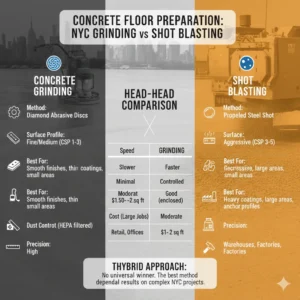
4. Grinding vs Shot Blasting: Head-to-Head Comparison
Here’s the real showdown.
| Factor | Concrete Grinding | Shot Blasting |
| Speed | Slower (500–1,000 sq ft/hour) | Faster (1,500–3,000 sq ft/hour) |
| Surface Profile | Fine to medium (CSP 1–3) | Aggressive (CSP 3–5) |
| Best For | Small to medium areas, polishing, leveling | Large industrial areas, heavy coatings |
| Dust Control | Excellent (HEPA systems) | Good (enclosed machines) |
| Coating Removal | Moderate (thin coatings) | Heavy (thick, bonded coatings) |
| Cost | Moderate ($1.50–$3.50/sq ft) | Lower for large jobs ($1–$2.50/sq ft) |
| Precision | High | Moderate |
| Noise Level | Moderate | High |
| NYC Building Suitability | Residential, retail, offices | Warehouses, factories, parking structures |
Bottom line? Grinding gives you control and finesse. Shot blasting gives you speed and power.
5. When to Use Grinding (Best Scenarios)
Choose concrete grinding when:
You’re Working on Smaller Spaces
Retail stores, office lobbies, residential basements — spaces under 5,000 sq ft benefit from grinding’s precision.
You Need a Smooth, Polished Finish
Planning polished concrete or a decorative overlay? Grinding creates the smooth base you need.
You’re Removing Thin Coatings
Old paint, light sealers, or single-layer epoxy? Grinding handles it without over-texturing.
You Want Minimal Dust
In occupied NYC buildings (like apartment complexes or retail stores), concrete dust control methods matter. Grinding with HEPA filtration keeps the air clean.
You Need to Level the Surface
Got humps, bumps, or uneven patches? Concrete floor leveling NYC contractors rely on grinding to create a flat plane.
Real-world example:
A boutique hotel in SoHo needed to refinish their lobby floor without closing down. Diamond grinding NYC allowed contractors to remove old sealer, level the slab, and prep for polished concrete — all while guests checked in upstairs.
6. When to Use Shot Blasting (Best Scenarios)
Choose shot blasting when:
You’re Covering Large Square Footage
Warehouses, distribution centers, manufacturing plants — anything over 10,000 sq ft benefits from shot blasting’s speed.
You Need an Aggressive Anchor Profile
Installing heavy-duty epoxy coatings or polyurea? You need CSP 4–5, and shot blasting delivers.
You’re Removing Stubborn Contaminants
Oil stains, grease buildup, tire marks, or thick adhesive residue? Shot blasting blasts them away (literally).
You’re on a Tight Timeline
Time is money in NYC. Shot blasting can prep a 20,000 sq ft warehouse in a single day.
You’re Dealing with Heavily Coated Floors
Removing multiple layers of old epoxy or urethane? Shot blasting cuts through it faster than grinding.
Real-world example:
A food processing facility in the Bronx had years of grease buildup and old epoxy. Brooklyn shot blasting services removed everything in 48 hours, prepped the surface to CSP 4, and got the new coating applied before production resumed.
7. Surface Profile (CSP) Standards You Should Know
Here’s something most contractors won’t explain clearly: surface profile isn’t just about “rough vs smooth.”
It’s measured using the Concrete Surface Profile (CSP) scale developed by ICRI (International Concrete Repair Institute).
CSP Scale Overview:
- CSP 1 — Very fine texture (like 80-grit sandpaper)
- CSP 2 — Fine texture (like 40-grit sandpaper)
- CSP 3 — Medium texture (like 16-grit sandpaper)
- CSP 4 — Coarse texture (like acid etching)
- CSP 5 — Very coarse texture (exposed aggregate)
What You Need for Different Coatings:
- Polished concrete → CSP 1–2 (grinding)
- Epoxy coatings → CSP 2–3 (grinding or light shot blast)
- Heavy-duty epoxy → CSP 3–4 (shot blasting)
- Polyurea/polyaspartic → CSP 4–5 (aggressive shot blasting)
Pro tip: Always test your concrete surface roughness standards with a CSP chip set before coating. It’s a $50 tool that prevents $5,000 mistakes.
8. Cost Breakdown: Grinding vs Shot Blasting in NYC
Let’s talk numbers.
How much does concrete floor prep cost in NYC? It depends on method, square footage, and existing conditions.
Concrete Grinding Cost NYC:
- Small jobs (under 1,000 sq ft): $3–$5 per sq ft
- Medium jobs (1,000–5,000 sq ft): $2–$3.50 per sq ft
- Large jobs (over 5,000 sq ft): $1.50–$2.50 per sq ft
Shot Blasting Cost NYC:
- Medium jobs (5,000–10,000 sq ft): $1.50–$2.50 per sq ft
- Large jobs (over 10,000 sq ft): $1–$2 per sq ft
Additional Costs to Consider:
- Surface contaminant removal → +$0.50–$1/sq ft
- Concrete crack repair before coating → $5–$15 per linear foot
- Concrete floor moisture testing NYC → $200–$500
- Dust barriers and HVAC protection → $300–$800
Example scenario:
A 10,000 sq ft warehouse in Queens needs heavy epoxy prep. Shot blasting costs $15,000–$20,000. Grinding would cost $25,000–$35,000 and take 3x longer.
For that project, shot blasting is the clear winner.
9. Common Mistakes in Concrete Prep (And How to Avoid Them)
Even experienced contractors mess this up. Here’s what to watch for:
Mistake #1: Skipping Moisture Testing
The problem: Installing epoxy over damp concrete causes delamination.
The solution: Always perform concrete floor moisture testing NYC using calcium chloride tests or RH probes.
Mistake #2: Using the Wrong CSP for Your Coating
The problem: Too smooth = coating won’t bond. Too rough = coating won’t level.
The solution: Match your prep method to your coating’s CSP requirements.
Mistake #3: Ignoring Existing Coatings
The problem: Grinding over thick epoxy just smears it around.
The solution: Use shot blasting or scarifying to fully remove bonded coatings.
Mistake #4: Poor Dust Management
The problem: Concrete dust spreads through HVAC systems, violating NYC building floor prep code.
The solution: Use HEPA-filtered equipment and seal off work areas.
Mistake #5: Rushing the Process
The problem: Incomplete prep = coating failure in 6–12 months.
The solution: Take the time to properly clean, profile, and test before coating.
10. Why NYC Buildings Have Unique Concrete Prep Challenges
NYC isn’t like anywhere else. Here’s why concrete preparation in NYC buildings is uniquely challenging:
Challenge #1: Old Concrete Slabs
Many NYC buildings are 50–100+ years old. The concrete is harder, more brittle, and often has multiple layers of old coatings.
Challenge #2: Limited Access
Tight loading docks, narrow elevators, and occupied spaces make it hard to bring in heavy equipment.
Challenge #3: Noise Restrictions
Co-op boards, building management, and city ordinances often restrict noisy work to specific hours.
Challenge #4: Environmental Regulations
NYC has strict rules about dust, debris disposal, and VOC emissions during concrete coating preparation NYC.
Challenge #5: High Standards
Commercial tenants and building owners expect perfection. There’s zero tolerance for coating failure.
The takeaway? You need a contractor who understands NYC-specific challenges — not just concrete prep in general.
11. How to Choose the Right Contractor in NYC
Not all NYC concrete contractors are created equal. Here’s your vetting checklist:
Experience with Your Building Type
Residential concrete floor prep is different from NYC commercial concrete prep. Find a contractor who’s done your exact type of project.
Proper Equipment
Ask about their grinders, shot blasters, dust collection systems, and moisture testing tools.
References and Portfolio
Request photos, testimonials, and contact info for past clients in Manhattan concrete grinding, Brooklyn shot blasting, or wherever you’re located.
Licensing and Insurance
Verify their NYC contractor license and $2M+ liability insurance.
Clear Communication
They should explain CSP levels, coating compatibility, and realistic timelines — not just quote a price.
Written Warranty
Get a warranty on surface prep quality, not just the coating.
12. Final Verdict: Which Method Wins?
Here’s the truth: there’s no universal winner.
The best method depends on your specific project.
Choose Concrete Grinding If:
- Your space is under 5,000 sq ft
- You need a smooth or polished finish
- You’re removing light coatings
- Dust control is critical
- You want precision and control
Choose Shot Blasting If:
- Your space is over 10,000 sq ft
- You need an aggressive anchor profile (CSP 4–5)
- You’re removing heavy coatings or contaminants
- Speed is a priority
- You’re prepping for industrial-grade epoxy
Hybrid approach: Many smart contractors use both methods on the same project — shot blasting for the main floor, grinding for edges and detail work.
Why Duraamen for Your NYC Concrete Prep?
At Duraamen, we’ve been helping NYC building owners, property managers, and contractors choose the right concrete surface prep methods for over 30 years.
Whether you’re renovating a warehouse in Queens or installing epoxy flooring in a retail store in Manhattan, we provide:
Expert consultation on grinding vs shot blasting
Full-service concrete floor prep services NYC
High-performance coatings designed for NYC conditions
Warranty-backed installation
Fast turnaround without compromising quality
Ready to prep your floor the right way?
Contact Duraamen today for a free consultation and project estimate. Let’s make sure your concrete surface is perfectly prepped — so your coating lasts 10+ years, not 10 months.
Visit us at nyc.duraamen.com or call to speak with a concrete prep specialist.
FAQ
1. What is better: grinding or shot blasting concrete?
It depends on your project. Grinding is better for smaller spaces, polished finishes, and fine surface profiles (CSP 1–3). Shot blasting is better for large areas, heavy coatings, and aggressive profiles (CSP 4–5). For most industrial epoxy jobs, shot blasting wins on speed and cost.
2. How much does concrete floor prep cost in NYC?
Grinding typically costs $1.50–$5 per sq ft depending on size and condition. Shot blasting costs $1–$2.50 per sq ft for large jobs. Additional costs include coating removal, crack repair, and moisture testing.
3. When should I use shot blasting instead of grinding?
Use shot blasting when you’re prepping large areas (10,000+ sq ft), need an aggressive anchor profile, or removing thick coatings. It’s faster, more cost-effective for big jobs, and creates the deep texture needed for heavy-duty epoxy.
4. What are the disadvantages of shot blasting?
Shot blasting is louder than grinding, less precise for small spaces, and can over-texture delicate surfaces. It’s also not ideal for polished concrete projects where a smooth finish is needed.
5. Is grinding concrete better than etching?
Yes. Grinding provides better surface profile consistency, removes coatings effectively, and doesn’t rely on chemicals. Acid etching is outdated for commercial applications and often fails to meet modern CSP standards.
6. How do I prepare concrete floors for epoxy coating in NYC?
Start with surface cleaning, then choose grinding or shot blasting based on your CSP needs (typically CSP 2–4 for epoxy). Perform moisture testing, repair cracks, and ensure the surface is clean, dry, and free of contaminants before applying epoxy.
7. What is a Concrete Surface Profile (CSP)?
CSP is an industry-standard scale (CSP 1–10) that measures surface roughness. Different coatings require different CSP levels. For example, polished concrete needs CSP 1–2, while industrial epoxy needs CSP 3–5.
8. Can I use shot blasting on residential concrete floors?
Yes, but it’s usually overkill for residential projects. Most homes benefit from grinding, which is quieter, more precise, and creates the right profile for decorative coatings or polished concrete.
9. How long does concrete floor prep take in NYC?
Grinding typically takes 1–3 days for a 5,000 sq ft space. Shot blasting can prep 10,000–20,000 sq ft in 1–2 days. Timelines vary based on existing coatings, surface condition, and coating removal complexity.
10. Do I need a special permit for concrete prep in NYC buildings?
Most concrete surface preparation work doesn’t require a permit, but check with your building management. If you’re working in a commercial high-rise or residential building, you may need to comply with NYC building floor prep codes, noise ordinances, and dust control regulations.
Final word: Whether you choose grinding or shot blasting, the key to a successful project is working with an experienced NYC concrete contractor who understands your building type, coating requirements, and timeline.
Don’t guess. Don’t cut corners. Get it right the first time.
Contact Duraamen today and let’s prep your concrete floor the professional way.