
Picture this: you just opened a commercial gym in NYC, on the fourth floor of a mixed-use building. The weights hit the floor. The bass pumps. Two hours later, your downstairs neighbor is filing a noise complaint with building management. Sound familiar?
Noise and vibration control flooring isn’t a luxury feature for NYC commercial spaces — it’s an operational necessity. In a city where gyms sit above offices, dance studios share walls with luxury apartments, and every square foot is shared with someone below, getting your floor system wrong has real consequences.
This guide covers everything property owners, facility managers, and fitout contractors need to know about choosing the right acoustical flooring systems NYC — with specific guidance for gyms, studios, and workspaces. We’ll break down the science, the materials, NYC code requirements, and why Duraamen is the name behind some of the city’s most demanding commercial floor solutions.
Table of Contents
- Why NYC Commercial Buildings Are Uniquely Noise-Sensitive
- STC vs IIC: The Numbers That Actually Matter
- Gyms & Fitness Centers: The Hardest Noise Problem to Solve
- Dance & Recording Studios: Precision Vibration Control
- Workspaces & Offices: The Subtler Noise Challenge
- Best Flooring Materials for Noise + Vibration Control
- Floating Floor Systems: When Standard Acoustic Flooring Isn’t Enough
- NYC Building Code: What You Actually Need to Know
- How Much Does Acoustic Commercial Flooring Cost in NYC?
- Why NYC Commercial Spaces Choose Duraamen
- FAQ
Why NYC Commercial Buildings Are Uniquely Noise-Sensitive
Most American cities have the luxury of space. NYC doesn’t. Commercial and residential uses are stacked vertically throughout Manhattan, Brooklyn, Queens, and the Bronx — often in the same building. A gym on floor 3, a law office on floor 4, residential units on floors 5–20.
That vertical density creates a unique acoustic challenge. Impact noise control flooring becomes critical because sound travels through concrete slabs far more efficiently than most people realize. A 45-lb dumbbell dropped on unprotected concrete can register as a loud thud three floors down.
Add NYC’s specific factors:
- Older building stock — Pre-war concrete slabs with no acoustic isolation built in
- Mixed-use zoning — Commercial tenants share structures with Class A residential
- Dense co-tenancy — Noise complaints directly affect lease renewals and operations
- NYC noise ordinances — Local Law and NYC Mechanical Code 2022 requirements for commercial spaces
- High property values — Building owners aggressively protect the residential tenant experience
This is exactly why vibration-resistant flooring NYC isn’t optional — it’s how you stay in business.
| Real-World Scenario: A boutique fitness studio in Brooklyn’s DUMBO neighborhood installed standard rubber flooring. Within 6 months, the creative agency below filed formal noise complaints. The studio closed for 3 weeks to retrofit a floating floor system — at 3x the original flooring cost. The right floor from day one would have cost a fraction of that. |
STC vs IIC: The Numbers That Actually Matter
Before choosing materials, understand the two acoustic ratings that determine whether your floor will actually solve the problem.

| Rating | What It Measures | Relevant For | NYC Target |
| STC (Sound Transmission Class) | Airborne sound — voices, music, speakers | Studios, offices, restaurants | 50+ STC recommended |
| IIC (Impact Insulation Class) | Impact noise — footfall, weights, equipment | Gyms, dance floors, high-traffic | 50–60+ IIC recommended |
| FIIC (Field IIC) | Real-world IIC in an actual building | All commercial applications | Typically 5–10 pts lower than lab IIC |
Here’s the insight most guides skip: STC and IIC address different problems. A floor with excellent STC but poor IIC will block music but let every footfall punch through. For NYC mixed-use buildings, you almost always need to address both simultaneously.
NYC’s Department of Buildings and most Class A buildings require a minimum IIC 50 and STC 50 for floors separating commercial from residential — but best practice in NYC’s demanding environment is targeting 55–60+ for both.
Gyms & Fitness Centers: The Hardest Noise Problem to Solve
Sound-proof flooring for gyms is one of the most technically demanding challenges in commercial flooring — because gyms generate both high-impact mechanical vibration AND airborne noise simultaneously.
The Three Sources of Gym Noise
- High-impact dropped weights — Free weight zones, Olympic lifting platforms: 30–100 Hz structure-borne vibration
- Cardio equipment vibration — Treadmills, rowing machines, bikes: continuous low-frequency transmission
- Airborne music + group fitness — Bass frequencies in class spaces penetrate standard concrete effectively
What Actually Works for Gym Flooring Noise Reduction
Effective gym flooring noise reduction systems require a multi-layer approach. Here’s what professionals specify for NYC gym installations:
- High-density rubber base layer (minimum 2.5″ thick in weight areas, 3″+ for Olympic lifting zones)
- Acoustic underlayment — Neoprene or mass-loaded vinyl (MLV) beneath the rubber layer
- Decoupled floating floor system — For extreme cases where weight rooms sit over occupied spaces
- Equipment isolation pads — Individual pads under treadmills, racks, and plate-loaded machines
- Perimeter isolation strip — Prevents flanking noise transmission through walls at floor level
Duraamen installs gym impact absorption flooring systems for NYC fitness centers that combine certified rubber underlayments with high-performance resinous surface coatings — acoustic performance and the durable, cleanable surface commercial gyms demand.
| Industry Insight: A 2.5″ thick high-density rubber tile achieves approximately IIC 52–55 on a 6″ concrete slab. Adding a 10mm neoprene underlayment boosts this to IIC 58–62 — the difference between recurring neighbor complaints and a quiet neighbor relationship. |
Dance & Recording Studios: Precision Vibration Control
Dance studios and recording spaces have the opposite problem from gyms: they don’t just need to keep noise out — they need to keep it in. And for recording studios, even minor structural vibration from HVAC or street traffic can ruin a take.
Studio flooring vibration control requires a fundamentally different approach. The priorities:
For Dance Studios
- Sprung floor systems — Absorb dancer impact, reduce transmitted vibration, protect joints
- Acoustic underlayment layer — Foam or cork beneath the performance surface
- Full perimeter isolation — Critical for preventing flanking transmission in NYC’s party-wall buildings
For Recording & Broadcast Studios
- Room-within-a-room construction — Floating slab isolated from building structure
- Vibration isolating flooring systems — Spring or neoprene isolator mounts under the finished slab
- Mass-loaded vinyl — Added to floating floor assembly for additional STC performance
- Continuous isolation strip — No direct contact between the floating floor and the structural walls
Manhattan studio flooring projects often involve coordination with building structural engineers — particularly in pre-war buildings where slab thickness significantly affects acoustic performance.
Workspaces & Offices: The Subtler Noise Challenge
Office noise problems in NYC are often misdiagnosed. Property managers assume it’s a soundproofing issue when the actual problem is impact noise — footfall from above, HVAC vibration, or equipment from adjacent spaces transmitting through the slab.
Office space vibration control floors address these through:
- Acoustic-backed LVT or carpet — Absorbs airborne sound and reduces footfall noise from above
- Cork or foam underlayment — Lightweight, achieves meaningful IIC improvement in office environments
- Resilient flooring for sound control — Rubber-backed sheet goods or acoustic vinyl in corridors
- Vibration-damping pads — Under server racks, printers, and mechanical equipment rooms
For flooring for multipurpose workspaces — co-working spaces that host events, recording sessions, and regular office use — a layered system combining acoustic underlayment with a hard-wearing resinous surface often provides the best performance-to-cost ratio.
Best Flooring Materials for Noise + Vibration Control in NYC
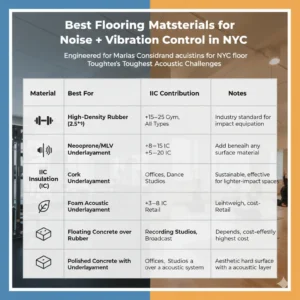
| Material | Best For | IIC Contribution | Notes |
| High-Density Rubber (2.5″+) | Gyms, weight rooms | +15–25 IIC | Industry standard for impact isolation |
| Neoprene/MLV Underlayment | Studios, gyms, all types | +8–15 IIC | Add beneath any surface material |
| Cork Underlayment | Offices, dance studios | +5–10 IIC | Sustainable, effective for lighter-impact spaces |
| Foam Acoustic Underlayment | Offices, retail | +3–8 IIC | Lightweight, cost-effective |
| Floating Concrete Slab | Recording studios, broadcast | +20–35 IIC | Maximum isolation; highest cost |
| Resinous/Epoxy over Rubber | Gyms, multipurpose | Maintains rubber IIC | Durability + cleanability over the acoustic system |
| Polished Concrete + Underlayment | Offices, studios | Depends on the underlayment | Aesthetic hard surface with an acoustic layer |
The most effective commercial acoustic flooring solutions aren’t single products — they’re layered systems. Duraamen designs custom multi-layer systems based on each space’s specific use, building structure, and acoustic targets.
Floating Floor Systems: When Standard Acoustic Flooring Isn’t Enough
For spaces where conventional acoustic underlayment doesn’t achieve required IIC/STC targets — Olympic lifting gyms, recording studios, nightclubs, or any heavy-use commercial space over occupied residential — a floating floor system is the professional answer.
A vibration-isolating flooring system completely decouples the finished floor from the building’s structural slab. There’s no direct contact between the two surfaces — only through resilient isolators that absorb mechanical energy before it transmits.
Key components of a commercial floating floor system:
- Neoprene or spring isolators — Mounted at regular intervals on the structural slab
- Sleeper framing — Structural grid sitting on the isolators
- Mass layer — Concrete or gypsum board poured over the frame
- Finished surface — Any appropriate commercial flooring material
- Perimeter isolation — No hard connection to walls, preventing flanking paths
Floating systems add 3–6″ of floor height — a critical consideration in NYC where ceiling heights are often already constrained. Duraamen team evaluates structural clearances as part of every acoustic flooring assessment.
NYC Building Code: What You Actually Need to Know
NYC has some of the most specific noise and vibration requirements for commercial buildings in the country. What matters for your flooring project:
- NYC Mechanical Code 2022 — Requires mechanical systems (pumps 3+ HP, fans) use resilient isolators to prevent structure-borne vibration
- IIC 50 minimum — Required for floors separating residential from commercial in most NYC Class A and B buildings
- DOB vibration monitoring — Required for certain building types and commercial equipment in sensitive locations
- Local Law compliance — Noise violations in NYC can result in fines and forced operational restrictions for commercial tenants
Non-compliance isn’t just a code issue — it’s a business risk. A commercial gym or studio that generates sustained complaints can face lease termination, DOB violations, and significant legal exposure.
| Pro Tip: Before finalizing your flooring spec for any NYC commercial space above an occupied floor, request a structural acoustic assessment. Duraamen partners with acoustic consultants to ensure every installation meets or exceeds code and practical performance targets. |
How Much Does Acoustic Commercial Flooring Cost in NYC?

| System Type | Space Type | Estimated Cost (Installed) | Notes |
| Basic rubber underlayment + surface | Office, retail | $4 – $7/sq ft | Good for modest noise improvement |
| High-density rubber flooring system | Gym, fitness center | $6 – $12/sq ft | Standard NYC gym spec |
| Rubber + neoprene isolation system | Gym, dance studio | $10 – $16/sq ft | Recommended for mixed-use buildings |
| Full floating floor system | Recording studio, heavy gym | $18 – $35/sq ft | Maximum isolation; full decoupling |
| Resinous coating over the acoustic system | Multipurpose commercial | $8 – $14/sq ft | Durable surface over acoustic underlayment |
| Acoustic consulting + assessment | All types | $800 – $3,000 | Critical for NYC mixed-use compliance |
The cost of getting it wrong is always higher. A 3-week closure for acoustic remediation in a commercial space generating $50K/month means $37,500 in lost revenue — far more than the correct installation would have cost upfront.
Why NYC Commercial Spaces Choose Duraamen
Duraamen has delivered commercial flooring NYC solutions across some of the city’s most demanding environments — from high-traffic gyms and professional studios to mixed-use workspaces in Manhattan, Brooklyn, and Queens.
- System-Based Approach: We design layered systems that address your specific acoustic targets, building structure, and use case — not just sell flooring materials
- NYC-Specific Expertise: We understand DOB requirements, building class standards, and the realities of installing in occupied NYC buildings
- Resinous + Acoustic Integration: Our specialty combines high-performance resinous surfaces with certified acoustic systems — a floor that’s acoustically effective AND commercially durable
- Full Project Management: Dust containment, building protection, scheduling around business operations — we handle NYC commercial installation complexity
Duraamen’s Related NYC Services
- Epoxy Flooring Systems — High-performance epoxy for commercial spaces and gym floors
- Polyurea & Polyaspartic Coatings — Fast-cure, durable coatings for commercial and fitness environments
- Urethane Concrete Flooring — Ideal for gym and fitness center floors; impact-resistant and seamless
- Industrial Floor Coatings — Heavy-duty systems for high-impact commercial applications
- Polished Concrete Flooring — Works with acoustic underlayment for offices and creative studios
- Elastomeric Flooring — Flexible, resilient surfaces for vibration-sensitive commercial spaces
- Commercial Floor Coatings — Full overview of Duraamen commercial flooring solutions
FAQ: Noise & Vibration Flooring for NYC Commercial Spaces
Q1: What is the best flooring for noise reduction in gyms?
High-density rubber (2.5″–3″+ thick) combined with a neoprene or MLV underlayment is the industry standard for gym flooring noise reduction. For NYC mixed-use buildings, a floating floor system may also be required to meet building code.
Q2: How do I reduce vibration from commercial flooring in NYC?
Use a layered vibration-isolating flooring system: resilient underlayment (neoprene, cork, or rubber) to absorb impact energy, plus perimeter isolation strips to prevent flanking. For heavy equipment, add individual isolation pads.
Q3: What flooring minimizes noise in recording studios?
Recording studios need floating floor construction with spring or neoprene isolators for maximum studio flooring vibration control. The floating slab completely decouples from the building structure, preventing structure-borne vibration from affecting recordings.
Q4: How much does acoustic flooring cost in NYC?
Standard commercial acoustic underlayment + surface: $4–$12/sq ft installed. Full floating floor systems for recording studios or Olympic gyms: $18–$35/sq ft. An upfront acoustic assessment ($800–$3,000) often saves significantly more in remediation costs.
Q5: What’s the difference between STC and IIC ratings?
STC measures resistance to airborne sound. IIC measures resistance to impact noise. NYC commercial floors separating from residential typically need both ratings above 50.
Q6: Do I need an acoustic assessment before choosing commercial flooring?
For any NYC commercial space sharing a building with residential units, yes. An acoustic assessment identifies your specific problem frequencies, existing slab performance, and the exact system needed to meet code and avoid complaints.
Q7: Can resinous flooring work with acoustic underlayment?
Absolutely. Duraamen regularly installs epoxy and polyaspartic systems over certified acoustic rubber underlayment — especially for gym floors and multipurpose commercial spaces. You get acoustic performance and a durable, seamless, easy-to-clean surface.
Q8: What NYC code applies to commercial gym flooring?
NYC Mechanical Code 2022 governs vibration from mechanical equipment. For acoustic separation between commercial and residential floors, NYC standards generally require IIC 50 minimum. Class A buildings often require IIC 55–60+.
Your Floor Choice Is a Business Decision
In NYC’s dense, mixed-use commercial landscape, noise and vibration control flooring isn’t just about being a good neighbor. It’s about protecting your operating license, your lease, and your reputation. A gym that generates sustained complaints doesn’t just face fines — it faces closure.
The right acoustical flooring system NYC — designed for your specific space, use case, and building structure — solves the problem permanently. The wrong choice creates a retrofit problem that costs 3–5x more than getting it right from the start.
Duraamen designs and installs commercial floor solutions in NYC that deliver real acoustic performance alongside the durability, aesthetics, and cleanability your space demands.
Ready to spec the right floor for your NYC gym, studio, or workspace? Visit nyc.duraamen.com or contact our team for a free commercial flooring assessment. Get it right the first time.